
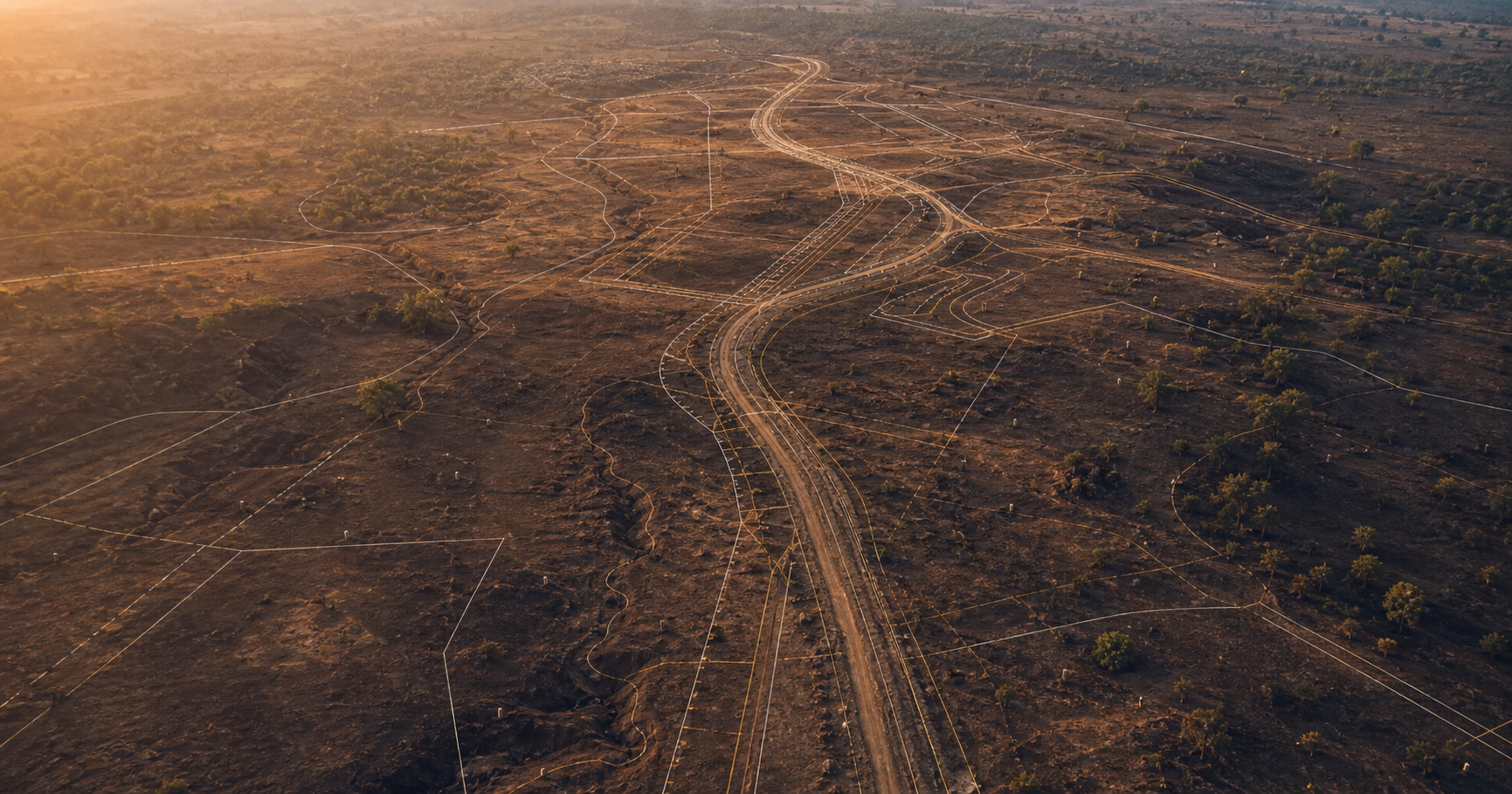
A project rarely starts falling behind on the day construction begins.
The delay usually starts much earlier.
A parcel of land is not fully available. An underground utility is discovered after excavation. A clearance is pursued too late. The demand estimate does not reflect how people will actually use the asset. A road reaches an industrial zone, but the last-mile connection remains unresolved. A building is completed, but nobody has planned properly for its operation.
By the time these problems become visible on site, many of the decisions that caused them have already been made.
India is entering another significant period of infrastructure development. Government capital outlay reached a budget estimate of ₹12.2 lakh crore for 2026-27. Roads, railways, industrial corridors, urban services, energy systems and public infrastructure are expanding across the country.
The size of this ambition is clear. The more important question is whether project preparation can keep pace with it.
The hidden cost of beginning too soon
Starting construction creates a strong impression of progress. Machinery arrives. People are deployed.
Physical work becomes visible.
But activity is not the same as readiness.
As of May 2026, the Ministry of Statistics and Programme Implementation’s PAIMANA infrastructure dashboard listed 1,987 monitored projects. Their original approved cost was approximately ₹37.1 lakh crore. The latest revised cost was approximately ₹42.5 lakh crore, a difference of nearly ₹5.4 lakh crore. The dashboard notes that some road-transport data was still being compiled.
Not every revision is evidence of poor planning. Project scopes change. Material prices move. Regulations evolve. Unexpected ground conditions emerge.
Even so, the size of the difference points to a basic truth: uncertainty becomes much more expensive after execution begins.
The pattern appears across sectors. The Comptroller and Auditor General’s 2025 audit of solar park development identified delays at several stages, including detailed project reports, land acquisition, financial closure, common infrastructure and grid connectivity. In some cases, delays in transmission and grid connectivity extended to more than five years.
These are not merely construction problems. They are preparation problems that eventually arrive at the construction site.
Infrastructure begins with an outcome
The first question in infrastructure planning should not be, “What can we build here?”
It should be, “What needs to work here?”
The distinction matters.
A commercial centre is not successful because the building is complete. It succeeds when people can reach it easily, businesses can operate efficiently and the surrounding market can support repeat activity.
An industrial zone is more than demarcated land. It requires freight connectivity, dependable power, water, digital infrastructure, workforce access and a realistic understanding of the industries it expects to attract.
A smart classroom is not a screen installed on a wall. It is a working combination of electricity, connectivity, appropriate content, teacher readiness, technical support and maintenance.
A resource project cannot contribute reliably to energy security if evacuation and logistics remain unresolved.
The asset is only one part of the outcome. The surrounding system determines whether that asset becomes useful.
This is why a project brief must define function before form. Who will use the infrastructure? What problem will it solve? What other systems must connect to it? How will demand change over time? What happens if one critical dependency fails?
Without clear answers, even technically sound construction can produce an incomplete result.
Site readiness is part of design
Land is often treated as an administrative requirement that sits outside the design process. In reality, land conditions shape almost every important project decision.
Ownership, access, topography, drainage, soil, existing settlements, environmental sensitivity and utility networks all influence design, cost and timing.
A site may appear available on a map while remaining unusable in practice. It may have unresolved ownership. It may require rehabilitation or resettlement. It may contain utilities that have not been recorded. It may rely on an access route that cannot support the traffic the finished project will generate.
These questions cannot be left for the contractor to discover.
Site investigation should influence the design before the design becomes difficult to change. Land availability should be assessed before procurement creates financial commitments. Utility mapping should happen before excavation. Environmental and social requirements should shape the programme rather than be treated as paperwork to complete later.
The aim is not to eliminate uncertainty. No serious project can do that. The aim is to identify uncertainty early enough for it to be managed.
Connections must be planned with the project
Infrastructure rarely creates value in isolation.
A railway station needs surrounding access. A logistics park needs road and rail connections. Housing requires water, power, mobility and social infrastructure. A hospital needs reliable utilities, emergency access and a wider referral network.
When these connections are planned separately, completion dates may not align. One component can be ready while the system remains unusable. India’s move towards integrated planning reflects this reality. As of February 2026, the PM GatiShakti National
Master Plan had brought infrastructure information from 57 central ministries and all states and Union Territories onto a platform containing more than 1,700 data layers. Its Network Planning Group had evaluated 352 projects worth ₹16.10 lakh crore.
The importance of this shift is not simply that more data is available. It is that roads, railways, utilities, economic zones, settlements and social infrastructure can increasingly be examined as parts of the same geography.
The PM GatiShakti Public platform now provides access to 230 approved datasets for site suitability analysis, alignment planning, connectivity mapping and compliance checks. Better visibility does not make difficult decisions disappear. It makes those decisions harder to postpone.
Risk should be priced before procurement
Every large project carries risk. The problem begins when that risk is vaguely understood or assigned to the party least able to control it.
Before procurement, a project should have a clear view of:
- Which land parcels are available and which remain unresolved
- What approvals are required and in what sequence
- Which utilities must be shifted
- Where the design is complete and where assumptions remain
- What demand projections depend on
- Which party controls each risk
- How changes will be evaluated and approved
- What delays could do to cost and viability
This is also where an honest Detailed Project Report matters.
A DPR should not be a document created mainly to move a project into the next approval stage. It should be a working test of whether the project is technically, financially, environmentally and operationally ready. The Bureau of Indian Standards describes the construction project lifecycle as a sequence that includes appraisal, project development, construction planning, tendering, construction, commissioning and handover. Its project-management guidance covers cost, time, quality, procurement, risk, sustainability and integration. That sequence contains a useful lesson. Tendering is not the beginning of a project. It comes after several stages of definition and preparation.
A tender issued against incomplete information does not remove uncertainty. It merely transfers the argument about that uncertainty into the contract.
The operator should have a seat at the planning table
Projects are often planned by one team, built by another and operated by a third.
That separation can create expensive blind spots.
A design decision that reduces initial cost may increase maintenance expenditure for years. Equipment may be procured without sufficient local servicing capability. A building may meet present capacity requirements but offer no practical way to adapt as demand grows.
The people responsible for operation and maintenance should therefore influence the project before the design is frozen. They understand where systems usually fail, which components are difficult to replace, what skills are locally available and what users need in everyday conditions.
Lifecycle planning also changes how value is measured. The cheapest project to build is not necessarily the least expensive asset to own. A more useful measure considers construction, energy use, maintenance, downtime, adaptation and eventual renewal.
This is especially important as climate risk becomes a normal part of infrastructure planning. A World Bank assessment notes that more than half the urban infrastructure India will require by 2050 is still to be built. Heat, flooding, water availability and changing demand cannot be treated as distant possibilities. Decisions about drainage, materials, cooling, energy, location and redundancy need to enter the brief before construction starts.
Good preparation should make execution less dramatic
There is a common belief that good execution is visible in the ability to solve crises quickly.
Sometimes that is true. Projects operate in the real world, and unforeseen problems will always require judgement.
But the strongest execution is often much less dramatic. Land is available when it is needed. Drawings are coordinated. Utilities have been mapped. Approvals follow a known sequence. Contractors receive reliable information. Decisions are made by people with clear authority. Changes are identified early enough to remain manageable.
The site moves steadily because the project was allowed to become ready.
This does not mean planning indefinitely. Excessive planning can become its own form of delay. The objective is not to wait for perfect certainty. It is to reach a level of maturity at which the remaining risks are visible, allocated and manageable.
India has already demonstrated that it can build at extraordinary scale. Its next infrastructure advantage can come from making scale more predictable.
That will require deeper site investigation, better data, stronger project preparation, realistic demand assessment, coordinated approvals, lifecycle thinking and clear ownership of risk. The most important work may not always be visible from the road.
But long before the first foundation is laid, it decides whether the project will move, whether it will last and whether it will serve the purpose for which it was built.